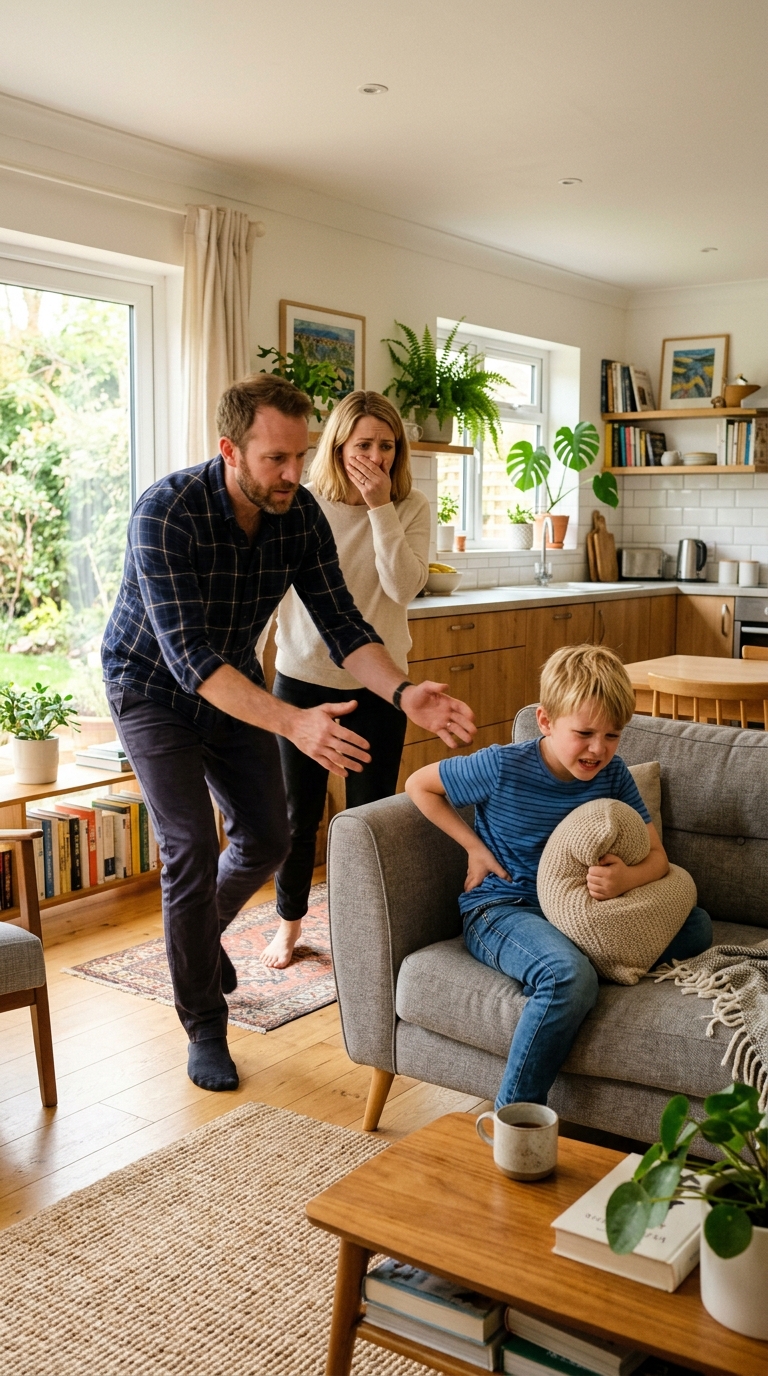
The Sunday Evening He Could Not Hide the Pain
Sunday evenings in San Diego always carried a strange, quiet weight.
Even after the sun sank low, the warmth still clung to the sidewalks and rooftops. The air above the freeway shimmered with the day’s lingering heat, and the sky faded into a tired mix of gold, gray, and pale orange. It was beautiful from a distance, but up close it felt worn—like a long week that refused to let go.
For Mason Holloway, Sundays were never peaceful.
They were never a soft ending to a family weekend. They were never casual. They were never easy.
They were the day his six-year-old son came back.
At exactly 6:50 that evening, Mason turned his black SUV onto a narrow residential street in a modest neighborhood near Chula Vista. The pavement was cracked in places, chain-link fences leaned slightly toward the sidewalk, and a few porch lights had already flickered on even though the sky still held some light. The small duplex at the end of the block looked exactly as it always did—faded paint, a crooked mailbox, and a patch of dry grass that never seemed to recover.
Mason noticed all of it.
But he never said a word.
Because his son was inside.
And that was the only thing that mattered.
The Arrangement He Never Trusted
Mason had spent twelve years building a successful home renovation company. He started with one truck, one borrowed ladder, and the kind of determination people only admire once it pays off. Now he owned a beautiful house in North County, had employees who relied on him, and had finally reached a point where money was no longer what kept him awake at night.
But none of that protected him from divorce.
Nothing shielded him from long court hearings, careful legal wording, and the painful way strangers reduced a family into schedules, signatures, and divided time.
His former wife, Sabrina Cole, had fought hard for shared custody. Years earlier, when Mason worked long days trying to keep his business alive, Sabrina had been the one home most often. That history followed them into court. The phrase “primary caregiver” seemed to outweigh everything Mason tried to explain.
So the order was made.
Shared custody.
Alternate weeks.
Final.
Mason followed every detail because the law required it—and because he believed that someday, somehow, doing everything right would matter.
Still, every Sunday evening, the same thought lingered quietly in the back of his mind.
He hated leaving his little boy behind.
And he hated waiting for him to come back.


Something Was Wrong Before a Word Was Spoken
The duplex door opened.
Mason straightened without realizing it.
Usually, six-year-old Owen burst outside like he had been launched by excitement itself. He normally came running with his backpack half-open, shoelaces loose, hair messy, and a hundred thoughts already spilling out of his mouth before he ever reached the car.
Usually, he smiled the moment he saw his father.
Usually, he ran straight into his arms.
This time, he did none of that.
Owen stepped carefully onto the small porch and paused.
Then he came down the steps slowly.
Far too slowly.
His small shoulders were tight. His back looked stiff. His movements were cautious in a way no six-year-old should ever move. Mason felt the change before he could fully understand it. A hard knot formed low in his chest.
He got out of the SUV immediately and walked toward him.
“Hey, pal,” he said softly. “You okay?”
Owen looked up and tried to smile, but it didn’t reach his eyes.
“Yeah, Dad.”
Mason crouched slightly. “You sure?”
“I’m okay,” Owen said quickly.
The answer came too fast.
There was no hug.
That alone was enough to make Mason’s stomach turn.
He reached gently for Owen’s backpack and noticed the boy tense at even that small movement.
“What happened?” Mason asked. “Did you fall or bump into something?”
Owen glanced toward the duplex door for a second, then looked back down.
“I’m just sore.”
“From what?”
A pause.
“Playing.”
“What were you playing?”
Another pause—longer this time.
“Outside stuff.”
The answer didn’t make sense. Owen was six. He usually gave too much detail, not too little. He loved dinosaurs, pancakes, drawing trucks, and asking why the moon followed the car at night. He didn’t suddenly become vague without a reason.
Mason opened the back door of the SUV carefully.
“Come on,” he said. “Let’s go home.”
The Drive That Felt Too Long
Getting into the car took longer than it should have.
Owen grabbed the door frame first. Then the seat. Then he lowered himself so slowly and carefully that Mason had to look away for a moment just to steady the panic rising inside him. The boy didn’t sit back the way he normally did. Instead, he shifted awkwardly and leaned forward, bracing one hand against the front seat.
Mason closed the door softly and slid into the driver’s seat.
For a few seconds, he didn’t start the engine.
He just looked into the rearview mirror.
Owen was trying very hard to act normal.
That was the part that broke him the most.
Not crying. Not complaining. Not even asking for help.
Just trying to make things easier for everyone else.
Mason drove toward home with both hands gripping the wheel tightly. Every small bump in the road made Owen tense. Every red light gave Mason another chance to glance back and watch his son pretend nothing was wrong.
He turned the radio off within a minute.
The silence felt heavier.
At one stoplight, he asked quietly, “Do you want me to call your doctor, buddy?”
Owen shook his head right away.
“No.”
“Did someone hurt you?”
The boy went completely still.
Then came the smallest reply.
“No.”
But it was the kind of “no” that came from fear—not truth.
Mason knew the difference.
He had learned it the hard way, through careful conversations and quiet observations over the years of co-parenting tension—through every moment his son came back just a little quieter than before.
By the time they pulled into the driveway, Mason already knew one thing for certain.
He wasn’t letting this go.
The Moment the Truth Started to Surface
The front gates slid open, warm light spilling across the driveway. Normally, Owen loved that moment. He loved racing inside to check if the dog had knocked his stuffed animals off the couch again. He loved peeking at the kitchen island to see what snacks were waiting. He loved being home.
That night, he barely looked around.
Mason had left dinner warming in the oven before heading out. Simple food. Owen’s favorites. Butter noodles, soft carrots, warm rolls.
None of it mattered.
Mason set the backpack down near the stairs. “Dinner’s ready,” he said gently.
Owen stayed near the doorway.
“You can come sit with me.”
Owen’s expression shifted immediately. He shook his head quickly.
“I don’t want to sit.”
Mason felt the room go still.
He walked over and knelt down so they were eye level.
“Owen.”
The boy’s mouth trembled.
Mason softened his voice even more. “Look at me, buddy.”
Owen finally did.
His eyes were already filling with tears.
“I can’t,” he whispered.
The words were so quiet Mason almost didn’t hear them.
“What do you mean you can’t?”
Owen’s lip quivered—and then the tears came all at once.
“It hurts.”
Mason closed his eyes for a brief second.
That was it.
That was the moment everything inside him shifted—clear, cold, focused.
He didn’t raise his voice. He didn’t bombard him with questions. He didn’t let panic take over.
He simply slipped one arm under Owen’s legs, the other around his back, and lifted him carefully.
“I’ve got you,” he said softly. “You’re safe. I’ve got you.”
Owen buried his face into his father’s shoulder and cried quietly all the way upstairs.
Under the Bright Bathroom Light
Mason carried him into the upstairs bathroom—it was bright, warm, and close to the bedroom. He set him down as gently as he could and crouched in front of him.
The house was silent except for Owen trying to steady his breathing.
Mason didn’t rush him.
He took a clean washcloth, ran it under warm water, and placed it gently in Owen’s hands—just to give him something to hold onto.
Then he said, “You’re home now. No one here is going to be mad at you. No one here is going to blame you. I just need the truth.”
Owen cried harder.
“She told me not to say.”
Mason stayed completely still.
“Who told you not to say?”
Owen looked down at the floor.
“Mom.”
The word hit like a stone.
Mason kept his voice steady, even though his heart was pounding hard enough to hurt.
“And anyone else?”
Owen nodded once.
“Her friend.”
He didn’t say boyfriend. He was only six. But Mason knew exactly who he meant.
Mason asked carefully, “Did they tell you what to say if I asked?”
A small nod.
“That I was sore.”
“Did they tell you to say it came from playing?”
Another nod.
Owen wiped his face clumsily with the washcloth and whispered, “She said you’d get mad. She said it would be worse if I told.”
Mason had never hated silence the way he did in that moment.
He wanted to storm out of the room. He wanted answers. He wanted the world to rewind one full week and give his child back untouched—laughing, carefree, normal.
Instead, he reached forward and gently cupped the side of Owen’s face.
“Listen to me,” he said. “You did nothing wrong. Nothing. You were right to tell me. I’m proud of you for telling me.”
For the first time since they got home, Owen leaned into his father’s hand.
That nearly shattered Mason.

The Call He Knew He Had to Make
When Mason examined his son more carefully, the truth became impossible to ignore.
This wasn’t the result of harmless play.
This wasn’t a small fall in the backyard.
There were signs this hadn’t happened just once. There were signs of fear that went far deeper than physical pain. There was a pattern no loving parent could overlook once they truly saw it.
Mason stood up so quickly he had to brace himself against the counter to stay steady.
Even then, he remained calm—for Owen.
He stepped into the hallway and pulled out his phone.
For a brief second, his old instinct surfaced. Call his attorney. Document everything. Move carefully. Follow the proper steps.
Then he looked back through the bathroom doorway and saw his son sitting there—small, shaken, holding a damp washcloth tightly in both hands.
This wasn’t about strategy anymore.
This was about immediate help.
He dialed 911.
When the operator answered, Mason spoke clearly.
“My name is Mason Holloway. My six-year-old son just came back from his mother’s house, and he appears to have serious injuries. He told me he was told to stay quiet. I need police and medical assistance at my address right now.”
The operator’s tone changed instantly.
She asked for the address, asked if the child was conscious, asked if he was safe at that moment.
Mason answered each question steadily.
“Yes, he’s with me. Yes, he’s awake. Yes, we’re safe. Please hurry.”
When he hung up, he went straight back to the bathroom.
Owen looked scared. “Am I in trouble?”
Mason dropped down to one knee beside him.
“No, buddy. Not at all. Help is coming because I believe you.”
The House Filled With People, but Not With Chaos
The first flashing lights appeared outside within minutes.
Blue and red reflections moved across the front windows and along the walls. The dog barked once, then went quiet, sensing something different in the house.
Paramedics arrived first—calm, steady, and gentle. One woman with kind eyes spoke directly to Owen in a soft voice, explaining everything before she did it. An officer stood nearby with a notepad, but she didn’t crowd him. She didn’t push him. She allowed him to stay close to Mason the entire time.
Mason answered questions. He repeated what Owen had said. He explained how the evening unfolded from the moment he saw his son stepping out of the duplex.
He was careful. Precise. Clear.
Inside, he felt like he was coming apart.
But he kept his voice steady because his son kept looking to him for reassurance.
At one point, Owen reached out from the stretcher and whispered, “Dad?”
Mason took his hand immediately. “I’m right here.”
“Are you coming too?”
“Always.”
The paramedic gave Mason a look that said more than words could.
Then they wheeled Owen out to the ambulance.
Mason climbed in beside him.
He didn’t let go of his hand.
The Longest Night
Hospitals at night always felt like a different world.
Bright. Quiet. Unnaturally awake.
Mason sat beside Owen’s bed while nurses moved in and out, while doctors spoke in careful, measured tones, while forms were signed and the same questions were asked again and again. Everyone was professional. Everyone was kind. But nothing about that night felt normal.
Owen drifted in and out of sleep, worn down more by fear than anything else.
Once, close to midnight, he opened his eyes and saw Mason still sitting beside him.
“You didn’t leave.”
Mason leaned closer. “I’m not going anywhere.”
A tear slid quietly from the corner of Owen’s eye.
“I was scared you wouldn’t believe me.”
Mason pressed his lips together tightly before answering.
“I will always listen to you,” he said. “Even when it’s hard. Especially when it’s hard.”
Later, a detective came into the room. Then a child services worker. Then another officer. The process moved quickly once the first reports were filed and the medical team documented what they had found.
Around two in the morning, a police officer returned and stood quietly at the doorway until Mason looked up.
“We made contact with your ex-wife and the man staying at the residence,” she said. “There was enough evidence to move forward tonight.”
Mason closed his eyes.
Not exactly out of relief.
Relief felt too small for what he was experiencing.
It felt more like taking the first full breath after being underwater for too long.
“Thank you,” he said.
The officer gave a small nod. “You did the right thing calling.”

Learning Safety Again
The days that followed blurred into each other.
Emergency orders were granted. Custody shifted quickly. Interviews continued. Appointments were scheduled. Mason stepped away from work without hesitation. His business could manage without him for a while.
His son couldn’t.
For the first few weeks, Owen refused to sleep alone. Mason set up a small bed on the floor beside his own, but most nights the boy still climbed into the big bed after a nightmare.
Mason never complained.
He would wake in the dark to a quiet voice calling, “Dad?”
And every time, he answered.
“I’m here.”
Healing didn’t follow a straight path.
Some mornings, Owen seemed almost like himself again. He asked for waffles. He argued with cartoons. He laughed when the dog chased his tail in circles.
Then, without warning, a sound or a memory would hit him, and his small body would tense all over again.
So Mason learned patience in a way he never had before.
They found a gentle therapist who knew how to talk to children without frightening them. They built new routines. Friday night pancakes. Storytime on the couch. Walks with the dog at sunset. A small night-light shaped like a moon.
Slowly, safety stopped being just a word.
It became something Owen could feel again.
One Year Later
A year passed.
Another Sunday evening came—but this time, it felt different from the very beginning.
The sky over the Pacific glowed gold, then softened into peach, then faded into a calm blue as evening settled over the hills. Mason and Owen sat on the back deck, plates of grilled cheese and sliced apples resting on their laps. Their dog wandered nearby, hopeful and patient.
The air was still.
No one was waiting for a handoff.
No one was watching the clock.
Owen, now seven, leaned back comfortably in his chair and laughed at something the dog had done with a tennis ball. The sound was light and easy—the kind of laugh a child should have.
Mason looked at him and felt a wave of gratitude so strong it almost hurt.
After a while, Owen turned to him.
“Dad?”
“Yeah, buddy?”
Owen paused for a moment.
Then he said, “Thanks for believing me that night.”
Mason set his plate aside.
He opened his arms, and Owen climbed into them without hesitation.
“Always,” Mason said softly. “That’s what I’m here for.”
The city lights began to glow in the distance as the sun disappeared completely.
And for the first time in a very long time, Sunday evening didn’t feel heavy.
It felt calm.
It felt safe.
It felt exactly the way home is supposed to feel.
10 Long Messages and Reflections
Sometimes the bravest thing a child can do is speak through a trembling voice, and sometimes the most important thing an adult can do is listen immediately—without hesitation, without excuses, and without trying to soften the truth.
Children don’t always have the words to explain their pain clearly, which means the adults who love them must learn to recognize the quiet changes—the forced smiles, the unusual silence, and the fear hidden inside simple answers.
A loving parent is not just someone who provides a home, food, and comfort, but someone who pays close enough attention to notice when something is wrong—even before the child can fully explain it.
There are moments in life when doing the right thing is not easy, not calm, and not convenient, yet those moments often define what real love looks like—because real love protects first and explains later.
When a child has been made to feel afraid of telling the truth, belief becomes a form of rescue, and one steady voice saying “I believe you” can become the first safe step toward healing.
Healing rarely happens all at once. Trust returns slowly. Peace comes back quietly. And the heart often needs far more time than the world expects in order to feel safe again.
Those who care for children should never ignore the small signs, because what seems minor from the outside may be the only signal a frightened child is able to send.
There is power in calm action. Panic may fill a room with fear, but steady love, clear thinking, and immediate protection can change the course of a child’s life forever.
A safe home is not defined by its size, wealth, or appearance, but by whether the people inside protect each other, speak the truth, and make space for healing without shame.
Every child deserves at least one adult who notices, who believes, who steps in, and who proves through action that safety is not just a promise—but a responsibility carried with love every single day.