PART 1
The evening I chose to trail my housekeeper, I convinced myself it was a matter of discipline.
That’s how men like me justify things.
Not emotion. Not curiosity. Principle.
My wife, Vanessa Carter, had mentioned it casually over dinner, as if she were commenting on the weather.
“She’s been taking food,” she said, slicing into her salmon without looking up. “Not enough to make a scene. Just… disappearing portions. I’ve been watching it for a few weeks.”
I folded my napkin slowly.
“How long?” I asked.
She shrugged. “Long enough to be intentional.”
Across the table, my son Ethan barely reacted, eyes fixed on his phone. The house was quiet in that curated way expensive homes tend to be—every sound softened, every surface controlled, every detail designed to reflect order.
And inside that order—
Something had moved without my permission.
That was the part that bothered me.
Not the food.
Control.
Her name was Maria Alvarez.
She had worked for us just under a year.
Quiet. Efficient. Nearly invisible.
The kind of employee people like me prefer—not because we respect them, but because they don’t require anything from us. No conversation, no emotional labor, no disruption to the rhythm of our lives.
She moved through the house like someone trained not to exist.
And every afternoon at exactly 4:15—
She packed food.
Carefully.
Always the same pattern. Small portions. Never enough to trigger immediate attention. Leftovers, fruit, bread, soup sealed in containers she brought from home.
It wasn’t random.
It was practiced.
The next day, I said nothing.
At 4:07, I stood in my office and watched her cross the service hallway.
At 4:15, she slipped into the kitchen, packed the food, and left through the side door.
I waited thirty seconds.
Then I followed.
At first, the drive felt normal.
Traffic. Lights. Stores. The outer shell of the city I knew.
Then the streets narrowed.
The sidewalks cracked.
Paint peeled from buildings like old skin.
Maria took a bus from a stop with no shade.
I followed from a distance, telling myself I was proving a point.
Employees who crossed lines would cross others.
Rules mattered.
Structure mattered.
That’s what I told myself.
But something else sat underneath that logic.
Something quieter.
I didn’t like that she had a life I couldn’t see.
The road eventually turned to dirt.
The kind of road that makes you question whether you should keep going—not out of fear, but because it feels like you’re stepping into something that doesn’t belong to you.
I almost turned back.
Twice.
But I didn’t.
The bus stopped in the middle of nowhere.
Maria got off alone.
No buildings. No people. Just heat, dust, and silence.
She started walking.
I parked farther back and followed on foot.
It took nearly twenty minutes before I saw it.
A cluster of structures that barely qualified as homes.
Crumbling walls. Rusted roofs. No paint, no order, no illusion of comfort.
This wasn’t poverty you pass by.
This was poverty that stays.
Maria didn’t hesitate.
She walked straight to one of the houses.
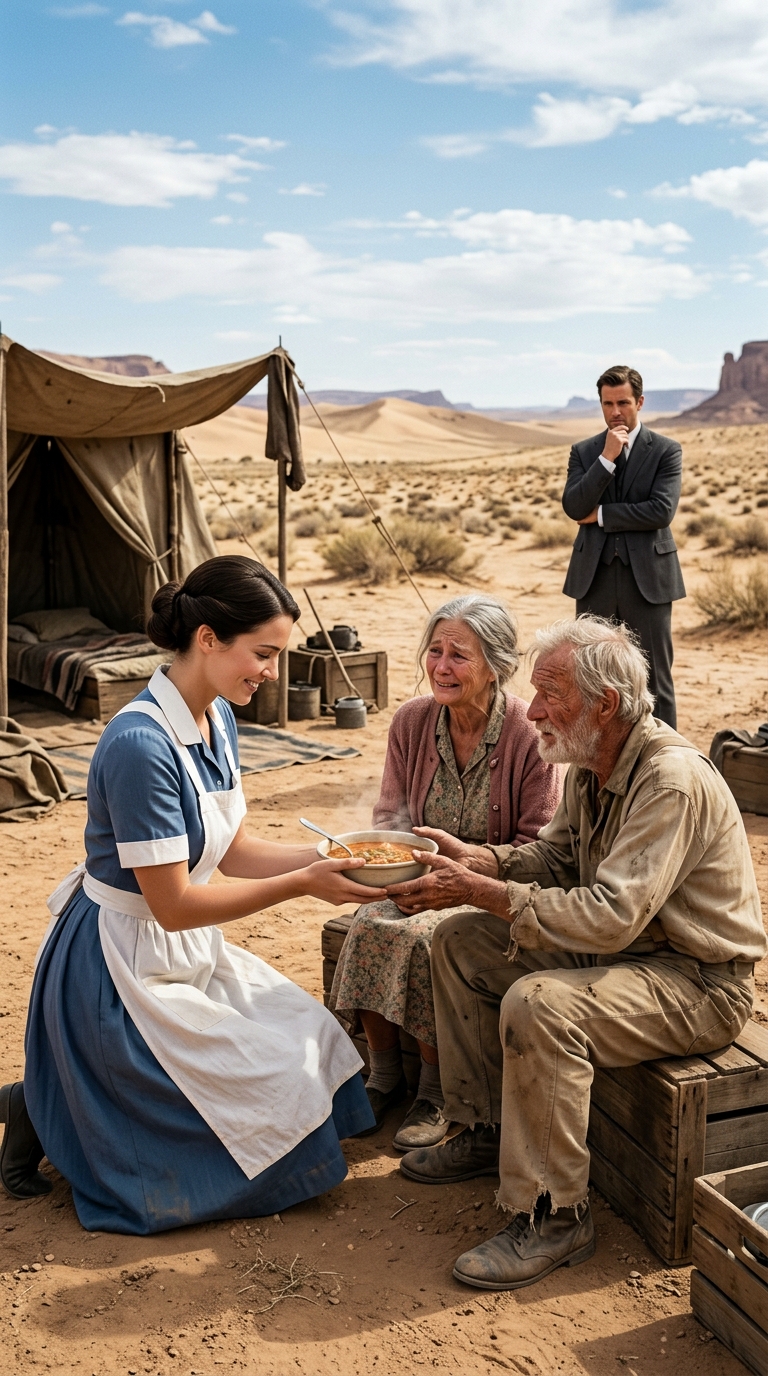
Two elderly people were sitting outside.
Not on chairs.
On crates.
Waiting.
Something shifted in me before I understood why.
She crossed into that yard—
And became someone else.
Her shoulders relaxed.
Her face opened.
Her voice changed.

“I’m here,” she said softly.
Not like an employee.
Like someone returning home.
She knelt in front of the old man first.
Touched his shoulder. His face.
Checked him.
Then she unpacked the food.
Served him.
Then the woman.
Carefully. Slowly. Patiently.
She cooled the soup before lifting it to their lips.
Tore the chicken into small pieces.
Wiped the woman’s mouth with a cloth.
Listened when she spoke nonsense.
Smiled anyway.
There was no performance in it.
No obligation.
Just care.
And then—
The old man raised his hand.
That’s when everything changed.
I recognized it.
Not immediately in words.
But in my body.
The shape of the fingers.
The ridge on the nail.
The scar near the thumb.
Memory doesn’t always arrive as thought.
Sometimes it hits like impact.
I leaned closer.
My heart started beating too fast.
Too hard.
The wall scraped my sleeve.
Dust clung to my shoes.
And suddenly—
I couldn’t look away.
Because I knew that hand.
I had seen it my entire childhood.
I left before she saw me.
I didn’t think.
Didn’t process.
Just walked back to my truck and drove.
That night, I didn’t sleep.
Vanessa asked if I was coming to bed.
I told her I already was.
But I wasn’t.
I was somewhere else entirely.
Fragments kept repeating.
The hand.
The way Maria fed them.
The house.
The crates.
By morning, I was irritable enough to snap at people for things that didn’t matter.
By afternoon—
I was back on that road.
This time, I arrived early.
Before Maria.
I walked up to the house alone.
Through a broken window, I saw them.
The old man asleep.
The woman sitting, hands moving through the air like she was remembering something that no longer existed.
The room was nearly empty.
No furniture worth naming.
No comfort.
Just survival.
And then—
A photo fell from a shelf.
I stepped closer.
Without thinking.
Without permission.
And saw my own face.
Eighteen years old.
Standing in front of a house I hadn’t thought about in decades.
My chest tightened.
My vision blurred.
Because I knew that photo.
And I knew—
Before I even looked back at the man—
What I was about to see.
PART 2
I didn’t need another second to confirm it.
The moment I saw the photograph, something inside me broke open with a clarity I had spent decades avoiding.
I turned back toward the man on the cot.
The same jawline, just hollowed by time. The same brow, heavier now. The same uneven rise in his chest when he breathed.
My father.
No hesitation. No doubt.
Just truth, arriving too late.
Then I looked at the woman.
Her hair thinner. Her face softer, worn by years instead of shaped by them. But the way her lips moved when she whispered to herself—the rhythm of it—
My mother.
Twenty-three years.
That’s how long I had been gone.
Not lost.
Not searching.
Gone.
By choice.
I stepped back from the window like the truth might burn me if I stood too close.
My pulse slammed against my ribs, fast enough to make me dizzy. Every excuse I had ever built—about ambition, distance, timing—collapsed under the simplest fact in front of me.
They were here.
Alive.
Hungry.
And I had never come back.
I must have made a sound.
Because my mother turned toward the window.
Her eyes found me—or something like me—and she smiled.
Not recognition.
Something else.
“Rosie?” she said softly. “You came back, sweetheart.”
My chest tightened so sharply I almost couldn’t breathe.
Rosie.
My sister.
Dead for seventeen years.
She didn’t know me.
Of all the punishments I had imagined—anger, rejection, blame—
This had never been one of them.
To return—
And not be remembered.
I stepped away before she could look closer.
Before she could see me clearly and still not know who I was.
Before I had to hear her say my name wrong again.
Footsteps sounded behind me.
I turned.

Maria stood there, completely still.
Not surprised.
Just… finished pretending.
“You shouldn’t be here,” she said.
No fear. No apology.
Just truth.
I swallowed.
“They’re my parents.”
The words sounded foreign, like they didn’t belong to the man I had become.
She held my gaze.
“Yes,” she said quietly. “I know.”
That hit almost as hard as everything else.
“You knew?”
“My aunt lives nearby,” she said. “I’ve been helping them for a long time.”
She didn’t elaborate.
She didn’t need to.
“Why didn’t you tell me?”
That question felt smaller even as I asked it.
She tilted her head slightly.
“Would you have listened?”
I opened my mouth—
And stopped.
Because I didn’t have an answer I could respect.
Inside the house, my mother called again.
“Rosie? Did you bring the book?”
Maria closed her eyes briefly, like she was resetting herself.
Then she looked at me again, and this time—
There was anger.
Real, earned anger.
“If you go in there,” she said, “don’t do it for yourself.”
I frowned. “What does that mean?”
“It means don’t walk in because you suddenly feel guilty and want to fix something,” she said. “He still has pride. She still has feelings. That’s their life.”
Her voice didn’t rise.
It didn’t need to.
“You go in,” she continued, “you go in quietly. Or you don’t go in at all.”
No one had spoken to me like that in years.
Not employees.
Not colleagues.
Not even my wife.
And standing there—
I realized I had no authority here.
Not the kind that mattered.
I nodded.
“Okay.”
For the first time in a long time—
I meant it.
She picked up the bag again.
“Then come in.”
The air inside hit me immediately.
Heat. Dust. Something faintly medicinal.
The kind of smell that stays in places where time doesn’t move fast enough to hide anything.
My father opened his eyes when I stepped in.
He looked at me.
Really looked.
Recognition moved through him slowly.
Not like mine.
More cautious.
More deliberate.
“You remember the road now?” he asked.
His voice was rough.
Not loud.
Which made it worse.
I swallowed.
“I—”
“Don’t,” he cut in. “Don’t come in here with that voice.”
The words landed clean.
No yelling.
No drama.
Just truth sharpened by years.
My mother smiled between us, completely unaware.
“Rosie brought a friend,” she said happily.
Maria moved beside her immediately, unpacking the food.
“I brought chicken today,” she said gently.
My mother clapped softly.
I stood there—
Completely useless.
That might have been the hardest part.
Not the house.
Not the hunger.
Not the years I lost.
But realizing that in this room—
I didn’t matter.
Maria did.
“She’s the one who’s been keeping them alive,” my father said.
I looked at him.
His eyes hadn’t softened.
Time had taken his strength.
Not his judgment.
“Why didn’t you call me?” I asked.
The question sounded childish even to me.
He let out a dry laugh.
“Call where?”
I had no answer.
Because there wasn’t one.
The silence stretched.
Then my mother reached for Maria’s hand.
“Don’t let them fight,” she whispered. “He always leaves when he fights.”
Maria squeezed her fingers.
“No one’s leaving.”
I sat down slowly on a crate.
It shifted under my weight.
Dust clung to my clothes.
Everything about me felt wrong in that space.
“I want to help,” I said finally.
My father didn’t hesitate.
“That’s what men say when they want forgiveness cheap.”
The words hit harder than anything else so far.
Because they were accurate.
“I was young,” I started.
He shook his head.
“Don’t explain,” he said. “Explain is what you use to make it smaller.”
I stopped.
Because he was right.
“I left,” I said instead. “And I stayed gone.”
The words felt heavier than anything I had said in years.
He watched me carefully.
Suspicious even of honesty.
“I let it get easier not to come back,” I continued. “And after that… I didn’t know how.”
My mother smiled at nothing.
A chicken scratched outside.
Maria said nothing.
Finally, my father asked, “And now?”
I looked at him.
At the house.
At everything I had avoided.
“Now I’m here.”
He studied me for a long time.
Then said only:
“We’ll see.”
That was all I got.
No forgiveness.
No rejection.
Just uncertainty.
That night, I drove home in silence.
Vanessa was waiting.
“Where have you been?” she asked, irritated. “You disappeared.”
I didn’t answer immediately.
I walked past her.
Straight into the house I had once believed was complete.
Then I said it.
“They’re alive.”
She frowned. “Who?”
“My parents.”
The room shifted.
“I thought they were dead,” she said.
“So did I.”
And as soon as the words left my mouth—
I realized how true they were.

PART 3
Vanessa didn’t understand at first.
She stood in the kitchen, arms crossed, waiting for the rest of the explanation like it would somehow restore the version of the world she preferred.
“You’re serious?” she asked.
“Yes.”
“And you just… found them?”
I nodded.
That wasn’t the whole truth.
But it was enough to start with.
Her reaction wasn’t shock.
Not really.
It was irritation.
The kind that comes when reality interrupts convenience.
“So what does that mean?” she asked. “For us?”
There it was.
Not Are they okay?
Not What happened to them?
Just—
What does this cost me?
I looked at her.
Really looked at her.
And for the first time, I saw something clearly that had been there all along.
We didn’t build a life.
We built a system.
Efficient. Structured. Predictable.
And completely disconnected from anything that required depth.
“It means I’m going back,” I said.
Her expression tightened. “For how long?”
“I don’t know.”
“That’s not an answer.”
“It’s the only honest one I have.”
She let out a short breath, already recalculating.
“You can’t just disappear,” she said. “We have responsibilities. The house. Ethan’s school. Your firm.”
I didn’t respond immediately.
Because for years, those things had been my language.
Obligations.
Structure.
Control.
“They’ve been living like that for years,” I said quietly.
“And whose fault is that?” she shot back.
The question landed harder than she intended.
Because I already knew the answer.
That night, I didn’t sleep in our bed.
Not out of anger.
Out of distance.
There are moments when you realize you’ve been standing in the wrong place for too long, and your body refuses to settle there again.
The next morning, I went back.
No hesitation this time.
No watching from a distance.
No excuses.
Maria opened the door before I knocked.
She looked at me for a second, measuring something.
Then stepped aside.
“You’re early,” she said.
“I’m not leaving,” I replied.
That was the first honest decision I had made in a long time.
The days that followed didn’t feel like redemption.
They felt like correction.
I brought food.
Not carelessly.
Not in excess.
Carefully, the way Maria had.
Portions that made sense.
Things they could actually eat.
I fixed the roof.
Or tried to.
It took three attempts and help from a neighbor who didn’t trust me but didn’t refuse the work either.
I sat with my mother while she spoke to ghosts.
Sometimes I answered.
Sometimes I just listened.
I learned how to do things I had once paid people to handle without thinking.
Cleaning.
Cooking.
Waiting.
That last one was the hardest.
Because nothing moved at my pace there.
Not my father’s trust.
Not my mother’s memory.
Not the weight inside my chest.
“You don’t get to rush this,” my father said one afternoon.
I was trying to repair a door that didn’t need urgency.
“I know,” I answered.
“Do you?” he asked.
I stopped.
Then nodded.
Because I was starting to.
Vanessa called every day.
At first.
Then every other.
Then less.
“You’re choosing this over your life,” she said during one call.
I looked around the small house.
At Maria feeding my mother.
At my father sitting quietly, watching me without comment.
At the dust, the heat, the stillness.
“No,” I said. “I’m choosing a different one.”
She didn’t argue.
Not because she agreed.
Because she understood.
We separated quietly.
No dramatic fight.
No public fallout.
Just distance turning into truth.
Ethan came once.
He stood outside the house, uncomfortable, unsure where to put his hands.
“This is where you’ve been?” he asked.
“Yes.”
He looked at everything.
Then at me.
“You’re different.”
I almost smiled.
“So are you,” I said.
He didn’t stay long.
But he came back again.
And again.
Each time a little longer.
My mother never fully recognized me.
Not the way I wanted.
But sometimes—
She looked at me and smiled like she felt something familiar.
And I learned to accept that.
My father changed more slowly.
Trust doesn’t rebuild itself just because you show up.
It rebuilds because you keep showing up.
One evening, as the sun dropped low enough to turn everything gold, he sat beside me outside.
“You stayed,” he said.
It wasn’t praise.
Just acknowledgment.
“Yes.”
He nodded once.
Then said something I hadn’t expected.
“Most don’t.”
That was the closest thing to forgiveness I would get.
Maria never softened.
Not in the way I thought she would.
But she stopped watching me like I was temporary.
“You’re learning,” she said one afternoon.
“That’s all I’m trying to do.”
She looked at me carefully.
“Good. Because they don’t need guilt. They need consistency.”
That stayed with me.
Months passed.
Then a year.
The house didn’t become perfect.
It became stable.
The roof held.
The food stayed.
The silence changed.
I stopped thinking in terms of fixing.
Started thinking in terms of staying.
Because that was the real difference.
One night, sitting outside alone, I realized something I hadn’t before.
For most of my life, I thought success meant building something no one could take from me.
A house.
A name.
A structure.
But I had built all of that on distance.
Distance from where I came from.
Distance from what I didn’t want to face.
And now—
Everything that mattered most existed in the place I had avoided.
I didn’t lose my life.
I walked away from the version of it that required me to ignore the truth.
The next morning, Maria handed me a container before I left to pick up supplies.
“For the road,” she said.
I took it.
Simple.
Ordinary.
But this time—
I understood what it meant.
Not charity.
Not obligation.
Care.
And for the first time in a long time—
I wasn’t outside of it.
I was part of it.