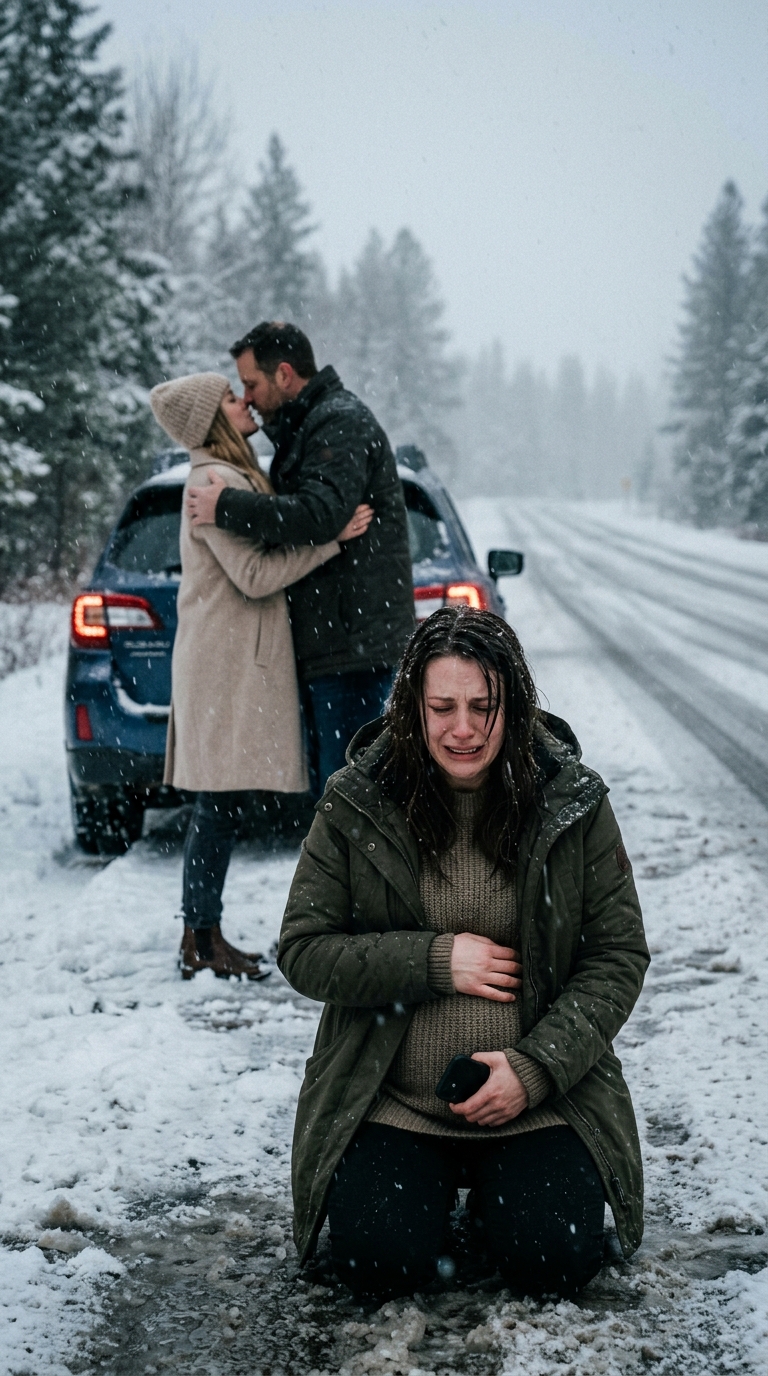
I was seven months pregnant when my husband left me on a mountain.
Even now, writing that feels unreal, because until that weekend, I still believed Garrett Ashford was the kind of man you could rely on in a crisis. We had been married for five years, and he insisted we celebrate our anniversary at a luxury resort high in the Rockies—the kind with cedar balconies, glowing fireplaces, and snow draped over everything like silk. He told me I needed rest before the baby arrived. He kissed my forehead in the car, rubbed my belly, and said the trip was for us.
I wanted to believe him. I always did.
That first evening, Garrett seemed distracted. He kept checking his phone, stepping away from dinner, muttering about investors, contracts, and urgent work matters. By midnight, he was pacing by the window while snow fell in thick, silent waves. Then he turned to me with that calm, polished expression I had mistaken for care for years and said he needed to leave for a few hours to handle something important.
“A few hours” turned into a slammed door, taillights vanishing into the storm, and me standing there in wool socks, one hand on my stomach, trying to soothe the baby as she kicked beneath my ribs.
At first, I told myself there had to be a real emergency. But Garrett forgot one thing: he left his tablet charging on the desk.
I didn’t go looking for answers. They found me.
Messages lit up across the screen. Brinley. Heart emojis. A hotel reservation. A photo taken less than ten minutes earlier. She stood in a silk robe, smiling into the mirror of a luxury suite at Aspen Ridge Lodge—another hotel an hour away. His reply sat just beneath it.

On my way. She suspects nothing.
My hands shook so badly I nearly dropped the tablet.
I sat on the edge of the bed, one hand pressed to my stomach, the other gripping the sheets, as the truth unraveled every lie I had been living. He hadn’t left for work. He had left his seven-months-pregnant wife alone on a remote mountain to be with his mistress—on our anniversary.
Outside, the wind intensified. Staff began knocking on doors, warning guests about worsening conditions and possible avalanche danger. I called Garrett once. Twice. Six times.
He declined every call.
Then the lights flickered.
Then the mountain groaned.
The sound that followed didn’t sound like snow. It sounded like the earth tearing apart above us. The walls shook. Glass exploded inward. The floor buckled beneath me. I fell hard, shielding my stomach just as a freezing wave of white crashed through the room.
And in that suffocating darkness—buried under snow and splintered wood—I realized something terrifying.
My husband hadn’t just betrayed me.
He had left me there to die.
I don’t know how long I was trapped.
Time dissolved under the weight of ice, debris, and fear. There was barely enough space to move. My left leg was pinned. Every breath burned. I could taste blood and dust. The cold felt alive, cutting through my coat, my skin, my thoughts.
But stronger than the fear was one thing.
My daughter was still moving.
I kept one hand on my belly and whispered through chattering teeth, over and over, “Stay with me. Stay with me. Mom’s here.”
Somehow, my phone was still in my pocket. The screen was cracked. The signal weak. But it worked.
I called 911 first and managed to say the resort’s name before the call dropped.
Then I called Garrett.
He answered on the third attempt.
I heard music in the background. Laughter. A woman’s voice.
“Garrett,” I gasped. “There was an avalanche. I’m trapped. Please—please come back. I can’t move.”
There was a pause.
When he spoke, his voice was colder than I had ever heard.
“No one is getting to you until rescue crews clear the roads.”
Tears streamed down my face. “I’m pregnant. Our baby—”
He cut me off.
“Don’t do this dramatic act right now, Colleen.”
Then I heard Brinley say something in the background, and his tone dropped lower.
“Since you already know, let’s stop pretending. I’m done. I was going to deal with this after the birth.”
The words hit harder than the avalanche.
“What are you talking about?”
“I’m talking about reality,” he said. “You’ll have the baby, and then we’ll make arrangements. You’ll do what I say, and things will stay comfortable for you. Fight me, and you’ll regret it.”

I could barely breathe. “You’re threatening me while I’m buried in snow?”
“I’m warning you,” he said. “And if you’re smart, you’ll keep your mouth shut about Brinley, about the company, about everything.”
The company. The way he said it—it stuck in my mind, even through the terror.
Then he hung up.
I screamed until snow filled my mouth.
What saved me wasn’t hope.
It was rage.
I clawed upward with bare hands, scraping against ice and splintered wood until my nails tore and blood warmed the snow around my fingers. I shouted whenever I could force air into my lungs. At some point, through the crushing silence, I heard something else.
A voice.
A man yelling that he could hear me.
His name was Weston Caldwell.
I knew that name because Garrett hated him. Weston was the rival he blamed for every lost deal and bruised ego. Garrett called him ruthless, dangerous, a vulture in a tailored suit. But the man who reached me through that wreckage didn’t sound ruthless.
He sounded determined to save a life.
He dug with his hands when the equipment failed. He tore through packed snow and broken beams while others warned him to stop. I remember the first clear glimpse of him—snow tangled in his hair, blood on his knuckle, eyes locked on me with fierce focus.
“Colleen,” he said, like he was holding me in place. “Stay awake. I’ve got you.”
I later learned he kept digging long after his gloves were soaked and his fingers had gone numb. He pulled me out piece by piece, shielding me when debris shifted again. By the time we reached the ambulance, I was drifting in and out, but I still remember him gripping my hand.
“Your daughter is still fighting,” he said. “So you fight too.”
At the hospital, I woke to monitors, stitches, bruises—and truth.
My baby survived.
Weston lost two fingers to frostbite saving me.
And Garrett, my husband, never came.
Recovery hurt in ways I never expected.
My body healed slowly, but the deeper wounds stayed. The humiliation of realizing how completely I had been deceived. The echo of Garrett’s voice on that call. And the truth that his cruelty didn’t stop with me.
While I was still in the hospital, reporters began circling—drawn by the avalanche, the resort scandal, and whispers that Garrett Ashford had vanished during it all. He showed up two days later with flowers, a lawyer, and a carefully constructed look of concern.

By then, I knew too much.
Weston didn’t push me. He just told me the truth.
Years earlier, his wife, Catherine, had struggled with severe depression after private medical information was leaked—first to the press, then to investors. It destroyed her dignity, her stability, and eventually her will to keep fighting. Weston had spent years trying to prove Garrett was responsible. Garrett wanted leverage in a business war, and Catherine became collateral damage.
At first, I couldn’t believe anyone could be that cruel.
Then the financial records surfaced.
The empire Garrett bragged about at charity events and boardrooms was built on lies. Shell accounts. Diverted assets. Investor fraud. Forged transfers. Hidden properties. The deeper the investigation went, the uglier it became. My husband hadn’t built a legacy.
He had built an illusion.
And forced everyone around him to live inside it.
I was done living that way.
The first thing I did was save everything—his messages with Brinley, hotel confirmations, call logs from the avalanche, threatening voicemails, internal files, financial records tying his personal betrayal to his professional crimes.
The second thing I did was refuse to stay silent.
When Garrett walked into my hospital room for a carefully staged reconciliation, he found cameras already waiting.
I told the truth.
I told them he had abandoned me on our anniversary trip. I told them he ignored my calls while I was buried under snow. I told them he admitted the affair, threatened me, and tried to control me through fear.
Then my legal team released the evidence.
Weston’s attorneys released theirs.
Garrett’s expression shifted in real time—from polished confidence to raw panic. And for the first time in years, I didn’t flinch.
The investigation moved quickly after that.
Board members turned against him. Investors cooperated. Former employees spoke out. Brinley disappeared the moment the money vanished.
Garrett was charged, tried, and eventually sentenced to fourteen years in prison for fraud and related crimes.
Justice didn’t erase what happened.
But it gave it weight.
It gave it consequence.
Months later, I gave birth to a little girl with steady eyes and a strong, stubborn cry.
I named her Grace Catherine.
Grace, because mercy found us in snow and ruin.
Catherine, because some losses deserve to be remembered with truth.
I started over—slowly, carefully.
I took a position at Weston’s company. I learned how to make decisions without fear. I learned how to sleep without waiting for betrayal.
Weston and I didn’t rush into anything. Real life doesn’t work like that. It’s slower. More careful. More earned.
But I learned something I hadn’t known before:
Kindness can be more powerful than charm.
And truth, once you choose it, becomes its own kind of freedom.
This is my story—not about the man who broke his vows, but about the woman who survived him.
If you’ve ever had to rebuild after betrayal, let this remind you: the end of one life can be the beginning of the truest one.
And if this story stayed with you, share the part that hit you hardest—because sometimes, speaking up is how we finally find our way back to ourselves.