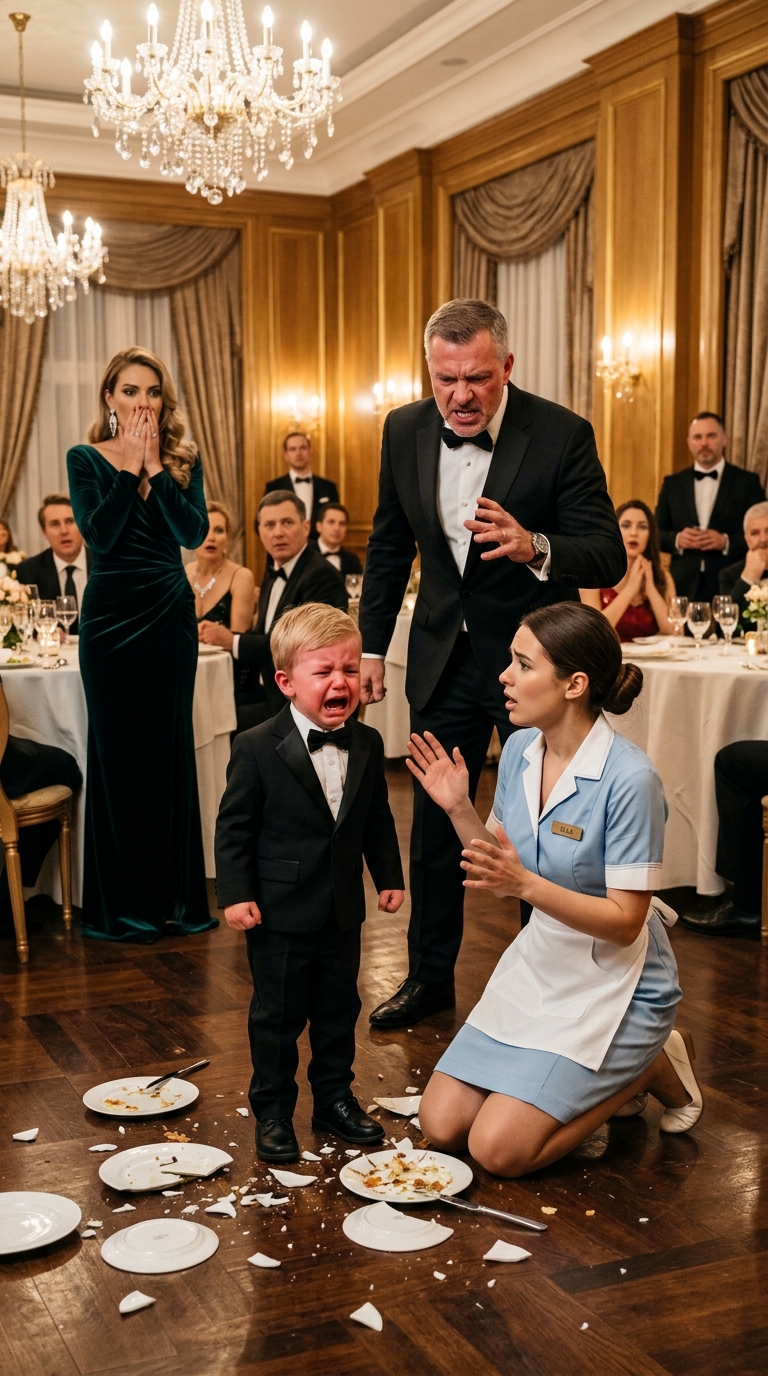
The sharp crack of porcelain shattering against polished marble cut through the air like a blade.
The sound echoed across the grand dining hall of the city’s most prestigious restaurant, silencing the soft notes of the piano and the delicate clink of crystal glasses. Men in tailored suits and women in silk gowns turned in unison. Shock. Irritation. Disdain. In a place devoted to refinement, scandal was the only unforgivable offense.
At the center of the room, seated at a table draped in flawless white linen, was a boy no older than seven. His small fists trembled on the tabletop, his red, swollen eyes blazing with a pain too heavy for such a fragile body. Without hesitation, he seized another plate and hurled it to the floor. The crash rang out again.
“Enough!” Victor’s voice thundered across the room, though it carried a crack beneath its authority.
Victor was a titan of industry, a man whose signature sealed multimillion-dollar contracts and whose name opened doors at the highest levels. He commanded respect everywhere—except here. He reached for his son’s arm, trying to restrain him.
“Stop this, Mason. You’re humiliating me,” he hissed, his jaw tight beneath the glow of crystal chandeliers.
But the boy tore free and knocked over a glass. Ice and shards scattered across the marble. This was not simple misbehavior. Since his mother’s death, Mason had lived in a mansion filled with staff but empty of warmth. Therapists came and went. Nannies lasted weeks. Victor, drowning in his own grief, buried himself in work, leaving his son surrounded by luxury yet starved of affection.

Whispers rippled through the room.
“With all his fortune, he can’t even manage his own child,” a woman muttered, adjusting her diamond bracelet.
“Money doesn’t buy manners,” her companion replied coolly.
Victor felt their judgment like heat on his skin. Important investors sat nearby. Journalists, too. By morning, headlines would not celebrate his latest merger—they would recount this humiliation. The restaurant manager hovered nervously, unwilling to confront the man who practically owned half the city.
As tension tightened around the table, in a quiet corner near the kitchen stood Hannah, a twenty-two-year-old waitress who had worked there barely a month. Her strategy for survival was invisibility. She spoke softly, moved quietly, and avoided attention. She came from a modest neighborhood where her mother worked double shifts to cover debts left by an absent father. This job paid for her younger brother’s medication. Losing it was not an option.
Yet while others saw a spoiled child, Hannah saw something else. She recognized the wild panic in Mason’s eyes — the same look her brother had during his anxiety attacks.
Her hands trembled around her tray. Staff were forbidden from interfering in personal matters. Breaking that rule meant immediate dismissal.
But Mason had grabbed a heavy fork and raised it toward a window. He was hyperventilating, trapped in a storm no one else could see.
Hannah set her tray down.
“Don’t,” another waiter whispered urgently.
She walked forward anyway.
Each step across the carpet felt impossibly loud to her. When she reached the table, she did not address Victor. She did not apologize. Instead, she knelt carefully among the broken porcelain, ignoring the shards that pressed into her knees. Bringing herself to Mason’s level, she said nothing. No commands. No reprimands.

She simply extended her hand.
Her palm was open — steady, patient, offering safety in silence.
The room seemed to hold its breath.
Mason froze. The fork slipped from his grasp and clattered to the floor. His frantic breathing slowed as his eyes met hers. Slowly, hesitantly, he placed his small hand into hers.
A profound silence fell over the restaurant.
Victor stepped back, stunned. The man who had hired the best specialists money could find watched as his son found calm in the quiet presence of an ordinary waitress.
Hannah felt the boy’s trembling fingers tighten around hers. She knew every eye judged her. She might lose everything for this. But in that moment, none of it mattered.
“Mason…” Victor’s voice softened, stripped of pride. Then, to her: “Who are you?”
Before she could answer, the manager rushed forward. “Sir, I apologize! She will be dismissed immediately—”
“No.”
The word came from Mason. Barely above a whisper, yet it echoed across the room. It was the first word he had spoken in months.
Victor’s composure faltered. For the first time since his wife’s death, he saw peace on his son’s face.
“Leave us,” he told the manager quietly. Then to Hannah, “Come with me. Both of you.”
In a private room away from the crowd, Victor demanded an explanation. Hannah spoke gently. Mason wasn’t misbehaving — he was terrified. When the world becomes too loud, sometimes breaking things feels like the only way to express fear. In those moments, children don’t need discipline. They need someone willing to sit beside them in the dark.
Her words pierced him more deeply than public shame ever could.
In desperation and humility, Victor offered her a position as Mason’s live-in tutor and caregiver. She could name her salary.

The next morning, a sleek black car pulled up outside Hannah’s small apartment. After a long conversation with her mother, she accepted.
The Harrington estate was overwhelming: sweeping staircases, glittering chandeliers, gardens that stretched endlessly. The head housekeeper, Mrs. Dalton, warned her coolly that mistakes would not be tolerated.
But Mason ran to her and wrapped his arms around her waist.
Over the following weeks, Hannah sat cross-legged on the floor building puzzles with him. She listened without rushing him. She allowed him to cry. She sang softly at bedtime. Slowly, laughter returned to hallways that had once felt like a museum of silence.
A month later, during a high-profile charity gala, disaster threatened again. Cameras flashed as Mason descended the staircase beside his father. The applause and lights overwhelmed him. He froze, panic rising fast.
Hannah did not hesitate. She hurried up the steps and knelt beside him.
“I’m here, Mason,” she whispered. “Close your eyes. Just listen to me. You’re safe.”
He clung to her, burying his face against her shoulder. His trembling eased.
Murmurs spread through the ballroom.
But Victor stepped to the microphone.
“Tonight,” he began, his voice steady but humbled, “I must admit something. I believed success could protect my family. I built an empire, but I neglected the one thing that truly mattered. This young woman gave my son something I could not purchase — patience, compassion, love. Real wealth isn’t in our accounts. It’s in our ability to kneel beside someone who is hurting.”
The room fell silent.
“Hannah is no longer simply an employee. She is part of this family.”
Applause rose — this time sincere.
That night, as the mansion quieted, Hannah tucked Mason into bed. Half asleep, he kissed her cheek.
“Thank you for staying,” he murmured.
In the hallway, Victor waited. He no longer looked at her as an employer assessing staff, but as a father grateful beyond words.
Sometimes life does not teach us through power or prestige, but through simple acts of courage. Through a hand extended in silence. Through love freely given.
And sometimes, salvation arrives not in grand gestures — but in the quiet strength of someone willing to kneel on broken porcelain for a child who feels alone.